SMUD Battery Rebate (2026): What My Energy Optimizer Partner+ Pays and How to Qualify
The SMUD battery rebate is a one-time enrollment incentive of $300 per kWh, capped at $6,000 per household. SMUD pays it to Sacramento Municipal Utility District customers who install a new eligible home battery and enroll it in the utility's My Energy Optimizer Partner+ program within 90 days of getting permission to operate. For a 13.5 kWh Tesla Powerwall, that's $3,240. Tesla owners also get up to $110 per battery each quarter.
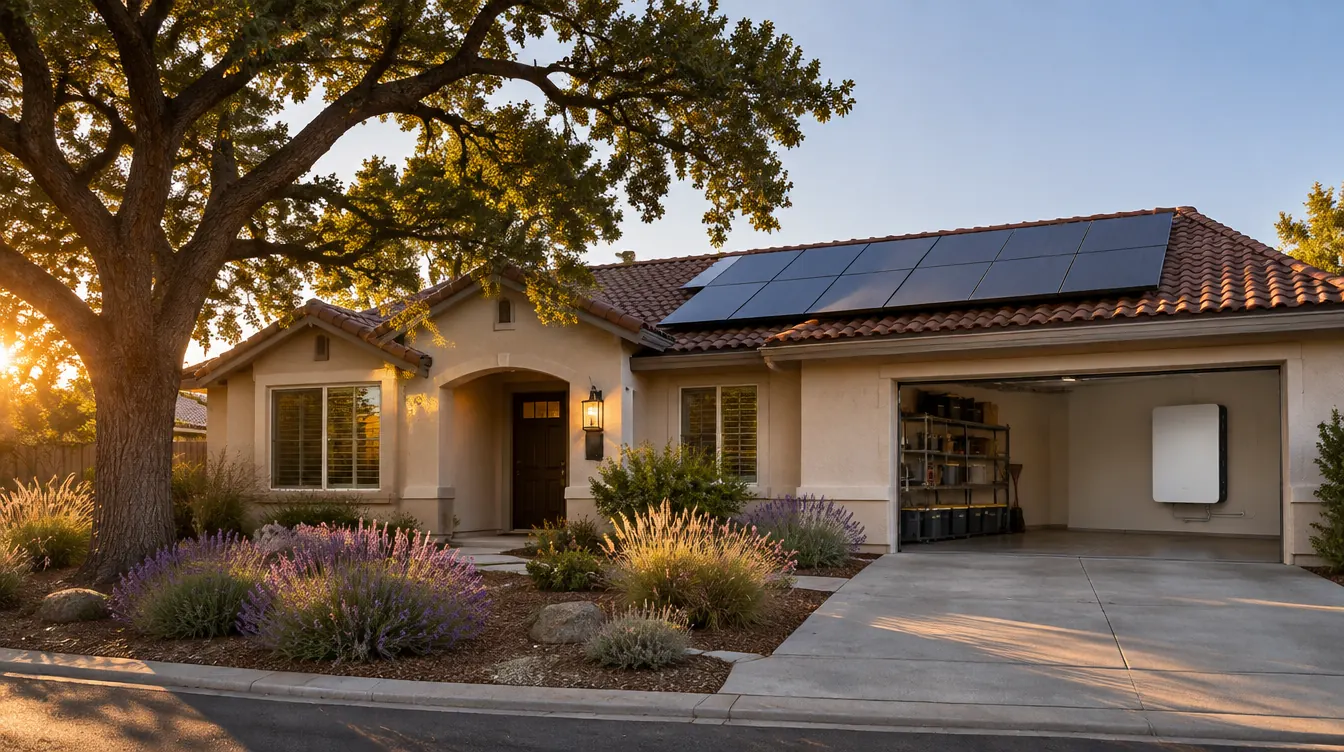
The rate dropped on September 23, 2026. Projects submitted to SMUD for interconnection by September 22 and enrolled by December 31, 2026 still get the old rate of $500/kWh (up to $10,000). Anything submitted on or after September 23 gets $300/kWh (up to $6,000). If you're getting quotes now, plan on the lower number.
Source: SMUD, Battery storage for homeowners, read November 6, 2026.
SMUD battery incentive at a glance
| Program | My Energy Optimizer® Partner+ (SMUD's home battery program) |
|---|---|
| One-time incentive | $300 per kWh × 80% of nameplate capacity, max $6,000 per household |
| Quarterly payments | Tesla Powerwall only: up to $110 (1 battery), $220 (2) or $330 (3+) per quarter |
| Eligible brands | Eguana, Enphase, Franklin, SolarEdge, Sonnen, Tesla |
| Required rate | SMUD Solar and Storage Rate (SSR) |
| Enrollment deadline | Within 90 days of SMUD permission to operate (PTO) |
| Commitment | 3-year minimum; leaving early means repaying a prorated share |
| Backup reserve | SMUD leaves at least 20% in your battery after every event |
| How it's paid | Check or debit card from SMUD, within 30 days of enrollment verification |
Sacramento homeowner looking at solar plus a battery? Compare quotes from vetted installers who know SMUD's interconnection and enrollment steps. Get a free solar quote →
How much is the SMUD battery rebate?
SMUD sizes the incentive to your battery's capacity. Its program terms spell out the formula: nameplate capacity (kWh) × 80% × the per-kWh rate, up to the household cap. The 80% is the share of the battery SMUD can use. The other 20% is always reserved for you.
- Current rate (interconnection submitted on or after Sept. 23, 2026): kWh × 80% × $300, max $6,000.
- Earlier rate (submitted by Sept. 22 and enrolled by Dec. 31, 2026): kWh × 80% × $500, max $10,000.
Because of the cap, the incentive stops growing at 25 kWh of nameplate capacity (25 × 80% × $300 = $6,000). A household adding a third or fourth battery past that point gets no extra enrollment money.
SMUD incentive by battery model
| Battery | Nameplate kWh | Submitted on/after Sept. 23, 2026 | Submitted by Sept. 22, 2026 | Quarterly pay? |
|---|---|---|---|---|
| Tesla Powerwall 3 / Powerwall 2 | 13.5 | $3,240 | $5,400 | Yes |
| Enphase IQ Battery 10C | 10 | $2,400 | $4,000 | No |
| Enphase IQ Battery 5P | 5 | $1,200 | $2,000 | No |
| Franklin aPower X | 13.6 | $3,264 | $5,440 | No |
| Franklin aPower Xyyy / Syyy | 15 | $3,600 | $6,000 | No |
| SolarEdge BAT-10k1P | 9.7 | $2,280 | $3,800 | No |
| Sonnen ecoLinx 10 (20 kWh) | 20 | $4,800 | $8,000 | No |
| Eguana Evolve LFP (28 kWh) | 28 | $6,000 | $10,000 | No |
Selected rows from SMUD's published incentive table, read November 6, 2026. SMUD lists dozens of model numbers. Check yours against the full table on smud.org before you sign.
Is there a $1,000 SMUD battery rebate?
No. SMUD doesn't offer a flat $1,000 battery rebate. Its incentive is based on capacity, so most whole-home batteries earn well over $1,000. At the current rate:
- A 5 kWh battery (such as an Enphase IQ Battery 5P) earns $1,200.
- A 10 kWh battery earns $2,400.
- A 13.5 kWh Tesla Powerwall earns $3,240, plus quarterly payments.
- Only very small units come in under $1,000. A 3.36 kWh Enphase battery earns $806.
If you saw a "$1,000 SMUD battery rebate" ad, it may be an old figure, an installer's own discount, or a mix-up with a different SMUD rebate. SMUD's own battery page is the only source that counts.
Who qualifies for the SMUD battery incentive
Based on SMUD's program page and the participant agreement (updated April 3, 2026), you need to:
- Be the SMUD residential customer of record at the address, with an account in good standing, and be at least 18.
- Install a new battery from an eligible brand: Eguana, Enphase, Franklin, SolarEdge, Sonnen or Tesla. SMUD's terms say other brands aren't eligible for the enrollment incentive.
- Complete a SMUD interconnection application for the equipment. Your installer normally does this.
- Be on SMUD's Solar and Storage Rate (SSR). The terms describe new participants as moving from the older net metering rate onto SSR.
- Enroll within 90 days of permission to operate. Miss this window and you lose the enrollment incentive.
- Keep the battery online. You need an always-on broadband connection to the battery, at your own cost.
Who's excluded: customers on SMUD's Medical Equipment Discount (MED) rate, individual rental units, and anyone who was in the program within the last three years. That last rule has an exception: an existing participant who adds a battery may get an incentive at SMUD's discretion. Income-qualified customers whose equipment SMUD pays for in full can join the program but don't get the enrollment incentive.

What you agree to when you enroll
The incentive is payment for letting SMUD use part of your battery. Read these terms before you count the money:
- Three-year minimum, auto-renewing. The agreement renews for further three-year terms unless you give written notice. Leave during the first term and you repay a prorated share of the enrollment incentive within 30 days of SMUD's invoice.
- Up to 240 events a year. SMUD's terms allow up to 30 events a month from June to September and 15 a month the rest of the year, each lasting up to four hours. Most dispatch lands in the weekday 5–8 p.m. peak, but events can happen at other times.
- A 20% floor. SMUD always leaves at least 20% charge at the end of an event, and you keep full access to stored power during an outage.
- SMUD's provider runs the battery. You authorize remote control, and the battery must be set to work with SMUD's time-of-day rate.
- Your bill could go up. SMUD's own terms warn that managing your equipment for the program "may increase your utility bill compared with if you did not participate."
- You keep it insured and connected. You'll need homeowner's insurance covering the equipment and a reliable internet connection.
Worked example: what a battery is actually worth on SMUD
This is our own calculation, not SMUD's. It shows the two things a battery earns a SMUD solar customer: the one-time incentive, and savings from using stored solar during the 5–8 p.m. peak instead of exporting it.
Why shifting pays: on the Solar and Storage Rate, SMUD credits exported solar at a flat 9.6¢/kWh. Peak power from 5–8 p.m. on weekdays costs 37.65¢/kWh in summer (June–September) and 17.76¢/kWh the rest of the year. Every kWh you store at midday and use at peak, instead of exporting it, saves the difference.
| Line item | Tesla Powerwall 3 (13.5 kWh) | Enphase IQ Battery 10C (10 kWh) |
|---|---|---|
| Solar shifted into the 5–8 p.m. peak, per weekday (assumption) | 10 kWh | 8 kWh |
| Summer peak savings (88 weekdays) | $237 | $190 |
| Non-summer peak savings (173 weekdays) | $123 | $98 |
| Estimated bill savings per year | ≈ $360 | ≈ $288 |
| Quarterly payments per year (Tesla only, "up to") | Up to $440 | $0 |
| One-time enrollment incentive (current rate) | $3,240 | $2,400 |
| Total over the 3-year minimum term | ≈ $5,640 | ≈ $3,264 |
How we got these numbers:
- Each delivered kWh at peak avoids buying power at the peak price. Storing it costs the 9.6¢ export credit you gave up, grossed up for battery losses. We assumed 90% round-trip efficiency.
- Summer, Powerwall: 10 × $0.3765 − (10 ÷ 0.9) × $0.096 = $2.70 per weekday × 88 weekdays ≈ $237.
- Non-summer, Powerwall: 10 × $0.1776 − (10 ÷ 0.9) × $0.096 = $0.71 per weekday × 173 weekdays ≈ $123.
- Weekday counts are for calendar year 2027 and ignore holidays. Weekends get no peak savings in this model.
- Rates are SMUD's published residential time-of-day prices as of November 6, 2026. SMUD's tariff sets the 9.6¢ export credit from June 1, 2026 and says SMUD updates it every four years. Peak prices can change sooner.
- Not included: the battery's purchase price, backup value during outages, SMUD's $27/month fixed charge (which you pay either way), and any events SMUD runs at times that don't match your own peak use.
The takeaway: on SMUD, the incentive does most of the work in the first three years. Peak shifting alone is worth a few hundred dollars a year, because SMUD's rates are among the lowest in California. A battery on SMUD is mostly a backup-power purchase that the incentive makes cheaper, not a fast payback. If the math matters to you, get a quote that models your own usage on SMUD's rate.

How to claim the SMUD battery incentive, step by step
- Check your brand and model against SMUD's incentive table. Six brands qualify, and the model number sets the amount.
- Get quotes and sign with a licensed installer. SMUD says it isn't responsible for the installation, so choose the contractor carefully.
- Your installer submits SMUD's interconnection application. New solar-plus-battery or battery-only systems pay a one-time interconnection fee. Adding a battery to existing solar doesn't.
- Install, pass inspection and get SMUD's permission to operate (PTO). Your 90-day clock starts at PTO.
- Enroll. Tesla owners enroll through Tesla's SMUD virtual power plant page. Owners of other brands use SMUD's enrollment form.
- Get paid. SMUD pays the enrollment incentive by check or debit card within 30 days of verifying your enrollment. Tesla quarterly payments start after that, prorated for the first quarter.
Questions go to SaveEnergy@smud.org. SMUD says it replies within two business days.
Federal tax credit and SGIP: what SMUD customers can't stack
No federal tax credit for homeowner-owned batteries in 2026. The 30% Residential Clean Energy Credit (Section 25D) covered home batteries of 3 kWh or more. The IRS says it isn't available for property placed in service after December 31, 2025. A battery installed in Sacramento in 2026 gets no federal credit if you own it. A federal benefit still exists for leased or PPA systems, but the leasing company claims it under the commercial Section 48E credit. Any savings reach you only if the lease price reflects it. Check that a leased battery still meets SMUD's rule that you have authority to control the equipment. More detail is in our 2026 solar tax credit guide.
SGIP, mostly no. The standard budgets of California's Self-Generation Incentive Program are limited to customers of the investor-owned utilities: PG&E, SCE, SDG&E and SoCalGas. SMUD is publicly owned, so for most households My Energy Optimizer Partner+ is the main battery incentive. The exception is SGIP's Residential Solar and Storage Equity budget for paired solar and storage. The CPUC says it's open to any low-income residential customer in California, including customers of publicly owned utilities. Check whether it's still open, and whether it can be combined with SMUD's incentive, with the program administrator listed on the CPUC's SGIP page. We couldn't confirm the stacking rules. Other publicly owned utilities set their own rules. See how they compare in our California solar guide.
Is a battery worth it on SMUD?
It depends on what you're buying it for:
- Yes, if backup power matters to you. Outages or working from home make a battery worth having. (Customers on SMUD's Medical Equipment Discount rate can't join the program.) The incentive takes $2,400–$3,600 off a typical single battery.
- Maybe, if you're adding solar anyway. SMUD's 9.6¢ export credit makes it more valuable to use your own solar at night than to export it. The battery is what lets you do that.
- Probably not, if you want the fastest payback. SMUD's rates are about half of PG&E's, so savings per kWh are smaller than in most of California. Our battery buyer's guide covers costs, and the solar break-even map shows payback by state.
Want to see how SMUD's program compares with other utilities that pay you to share a battery? Read our virtual power plant guide.
Want real numbers for your home on SMUD's rate? One short form gets you quotes from vetted local installers. No obligation. Get a free solar quote →
Frequently asked questions
How much is the SMUD battery rebate in 2026?
For projects submitted for interconnection on or after September 23, 2026, SMUD pays a one-time enrollment incentive of $300 per kWh on 80% of the battery's nameplate capacity, capped at $6,000 per household. That works out to $3,240 for a 13.5 kWh Tesla Powerwall and $2,400 for a 10 kWh battery. The money is paid by check or debit card after you enroll in SMUD's My Energy Optimizer Partner+ program.
Is there a $1,000 SMUD battery rebate?
No, SMUD doesn't offer a flat $1,000 battery rebate; its incentive is sized by battery capacity, so most whole-home batteries get well over $1,000. At the current rate a 5 kWh battery earns $1,200, a 10 kWh battery $2,400 and a 13.5 kWh Powerwall $3,240. Only very small batteries, like a 3.36 kWh Enphase unit ($806), come in under $1,000.
Who is eligible for the SMUD battery incentive?
You're eligible if you're the SMUD residential customer of record, you install a new Eguana, Enphase, Franklin, SolarEdge, Sonnen or Tesla battery, you move to SMUD's Solar and Storage Rate, and you enroll within 90 days of permission to operate. Customers on the Medical Equipment Discount rate and individual rental units aren't eligible.
Can I still get the higher $10,000 SMUD battery incentive?
Only if your project was submitted to SMUD for interconnection by September 22, 2026 and you enroll by December 31, 2026. Projects submitted on or after September 23, 2026 get the lower incentive of $300 per kWh, capped at $6,000.
Do I have to pay the SMUD battery incentive back if I leave the program?
Yes, you repay a prorated share if you leave before the three-year minimum term ends. SMUD invoices you for the prorated amount, due within 30 days. If you sell the home, the agreement can transfer to an eligible buyer who takes over your obligations.
Will SMUD drain my battery and leave me without backup power?
No, SMUD's program always leaves at least a 20% reserve at the end of an event, and you keep full access to stored power during an outage. Under the program terms, SMUD can call up to 240 events a year, each lasting up to four hours, with most falling in the weekday 5 to 8 p.m. peak.
Can I get the 30% federal tax credit on a home battery in 2026?
No, the federal Residential Clean Energy Credit (Section 25D), which covered home batteries of 3 kWh or more, doesn't apply to anything placed in service after December 31, 2025. A federal benefit still exists for leased or PPA systems, but the leasing company claims it under the commercial Section 48E credit, not you.
Can SMUD customers get California's SGIP battery rebate?
Mostly no: SGIP's standard battery incentives are limited to customers of PG&E, SCE, SDG&E and SoCalGas, so most SMUD customers rely on SMUD's own incentive instead. The exception is SGIP's Residential Solar and Storage Equity budget for paired solar and storage, which the CPUC says is open to any low-income residential customer in California, including customers of publicly owned utilities like SMUD.
Is the SMUD battery incentive taxable?
SMUD's program terms say the quarterly payments (currently Tesla-only) are taxable and reported to the IRS above $600 a year. The terms don't say how the one-time enrollment incentive is treated, so ask a tax professional before you file.
Facts verified
Every figure on this page was checked against the source below on November 6, 2026. SMUD can change incentives at any time without notice, so confirm with SMUD before you sign a contract.
- Incentive rates, the Sept. 22/23 cutoff, the 90-day rule, eligible brands, per-model amounts, Tesla quarterly amounts, eligibility exclusions and the interconnection fee: SMUD, Battery storage for homeowners.
- The 80% capacity formula, 3-year term and prorated repayment, payment method and timing, the 240-event cap, the TOD optimization requirement, the bill-increase warning and the tax treatment of quarterly payments: SMUD My Energy Optimizer Partner+ Participant Agreement (updated 04/03/26).
- Time-of-day prices (summer peak $0.3765, non-summer peak $0.1776) and the 9.6¢ Solar and Storage Rate export credit: SMUD Residential rates.
- The 9.6¢ export rate effective June 1, 2026 and the 5–8 p.m. peak: SMUD news release, April 27, 2026. The four-year update cycle: SMUD Rate Schedule SSR.
- The 25D credit ending for property placed in service after December 31, 2025, and battery storage of 3 kWh or more qualifying before then: IRS, Residential Clean Energy Credit.
- SGIP's standard budgets limited to PG&E, SCE, SDG&E and SoCalGas customers, and the Residential Solar and Storage Equity budget open to low-income customers of any California utility: California Public Utilities Commission, SGIP.
- SMUD at about 17¢/kWh versus PG&E at about 39¢/kWh on average: sourced in our California solar guide.
- Assumptions, labeled: the worked example's 90% round-trip efficiency, 8–10 kWh shifted per weekday, holiday-free 2027 weekday counts and full quarterly Tesla payments are our assumptions, not SMUD figures.
- Images are AI-generated illustrations, not photos of a specific SMUD customer or product.