NYC Home Battery Incentives (2026 Guide)
Three programs stack in the five boroughs: NYSERDA's per-kWh incentive, the city's 30% property tax abatement, and Con Edison's summer payments.
Updated
On this page
A home battery in New York City can earn up to $11,250 from NYSERDA, a property tax break worth 30% of the remaining cost, and up to about $338 a summer from Con Edison. How much you get depends mostly on one thing: whether your address is in a state-designated Disadvantaged Community. That covers about half the city. The federal battery credit ended December 31, 2025, so these local programs now do the heavy lifting.
NYC battery incentives at a glance
| Incentive | What it's worth | Status |
|---|---|---|
| NYSERDA Residential Storage Incentive (Con Edison region) | $250/kWh, up to 25 kWh (max $6,250) | Open: Block 1, about 88% unclaimed |
| NYSERDA Inclusive / Disadvantaged Community rate | $450/kWh, up to 25 kWh (max $11,250) | Open since Apr 13, 2026, about 79% unclaimed |
| NYC Solar & Storage Property Tax Abatement | 30% of eligible cost over 4 years, max $250,000 | Open for systems in service 2024–2034 |
| Con Edison Bring Your Own Battery | $100 per kW of average summer performance | Open; Tesla and SolarEdge so far |
| NY sales-tax exemption | No state or city sales tax (8.875% in NYC) | Extended through June 1, 2028 |
| Federal credit (25D) | Was 30% | Expired Dec 31, 2025 |
How much does NYSERDA pay for a home battery in NYC?
NYSERDA pays a fixed amount per kilowatt-hour of storage, for up to 25 kWh per home. Nearly all of NYC is in the Con Edison region. The exception is the Rockaways in Queens, which are served by PSEG Long Island and fall under NYSERDA's separate Long Island storage incentive. We read the live block data from NYSERDA's dashboard on November 11, 2026:
| Block | Rate | Max per home (25 kWh) | Opened | Remaining |
|---|---|---|---|---|
| Con Edison, Block 1 | $250/kWh | $6,250 | Jun 17, 2025 | ~88% |
| Inclusive / Disadvantaged Community, Block 1 | $450/kWh | $11,250 | Apr 13, 2026 | ~79% |
You don't apply yourself. NYSERDA pays through participating contractors, who reserve the incentive and usually take it off your price upfront. NYSERDA says the higher rate goes to homeowners who are income-eligible or who live in a Disadvantaged Community.
One thing to ask your installer: NYSERDA has started tying its incentive to enrollment in your utility's "bring your own battery" program. Upstate utilities were first in March 2026. Ask whether your project must enroll in Con Edison's program (below) to keep the NYSERDA money. We couldn't confirm the Con Edison timing from NYSERDA directly.
Is your home in a Disadvantaged Community?
Probably more likely than you think. About 49% of New York City residents live in a state-designated Disadvantaged Community census tract. In the Bronx it's 89%. We calculated these shares from the state's tract-level data, weighted by population:
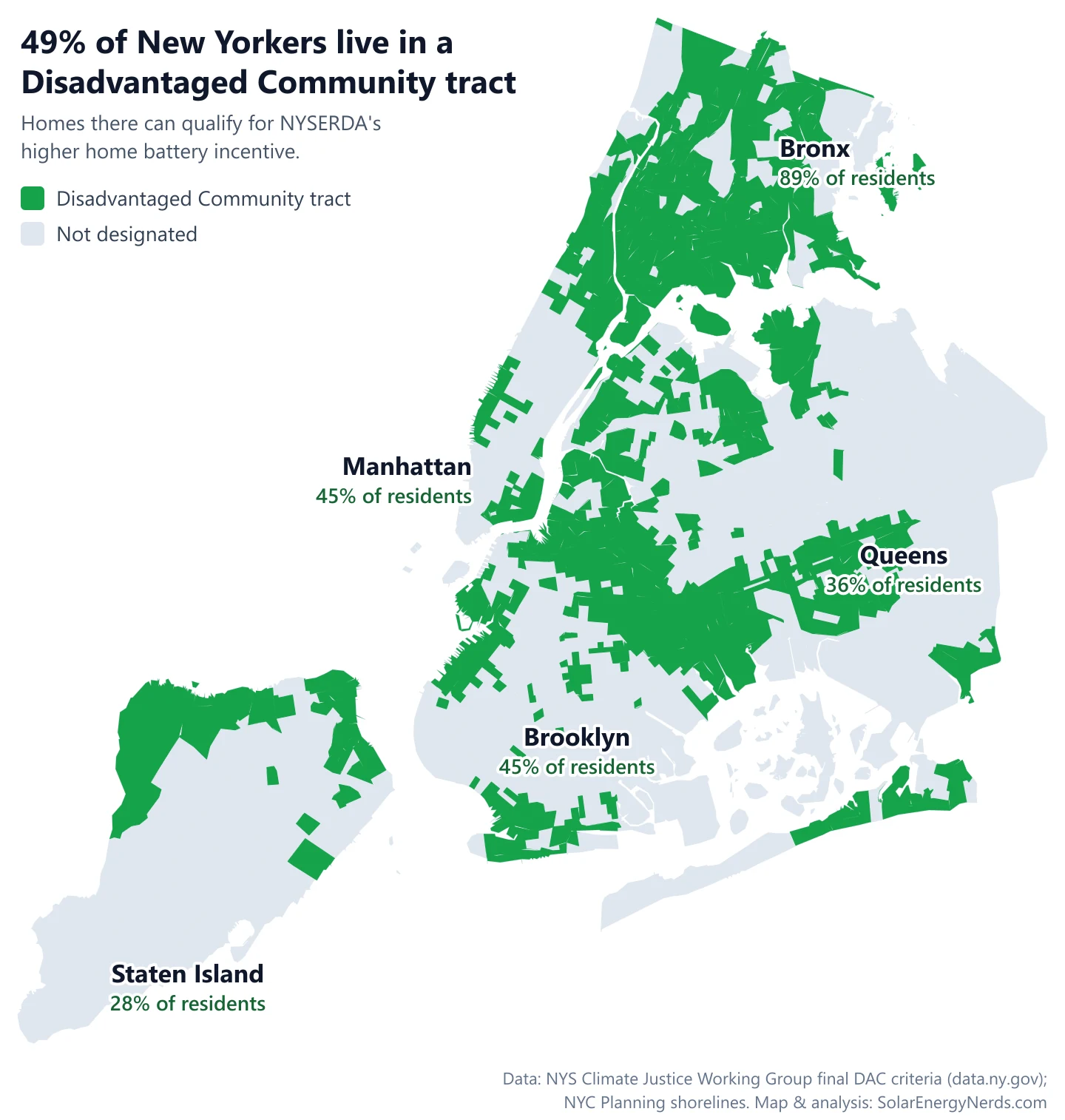
Use this map on your site (free, with credit)
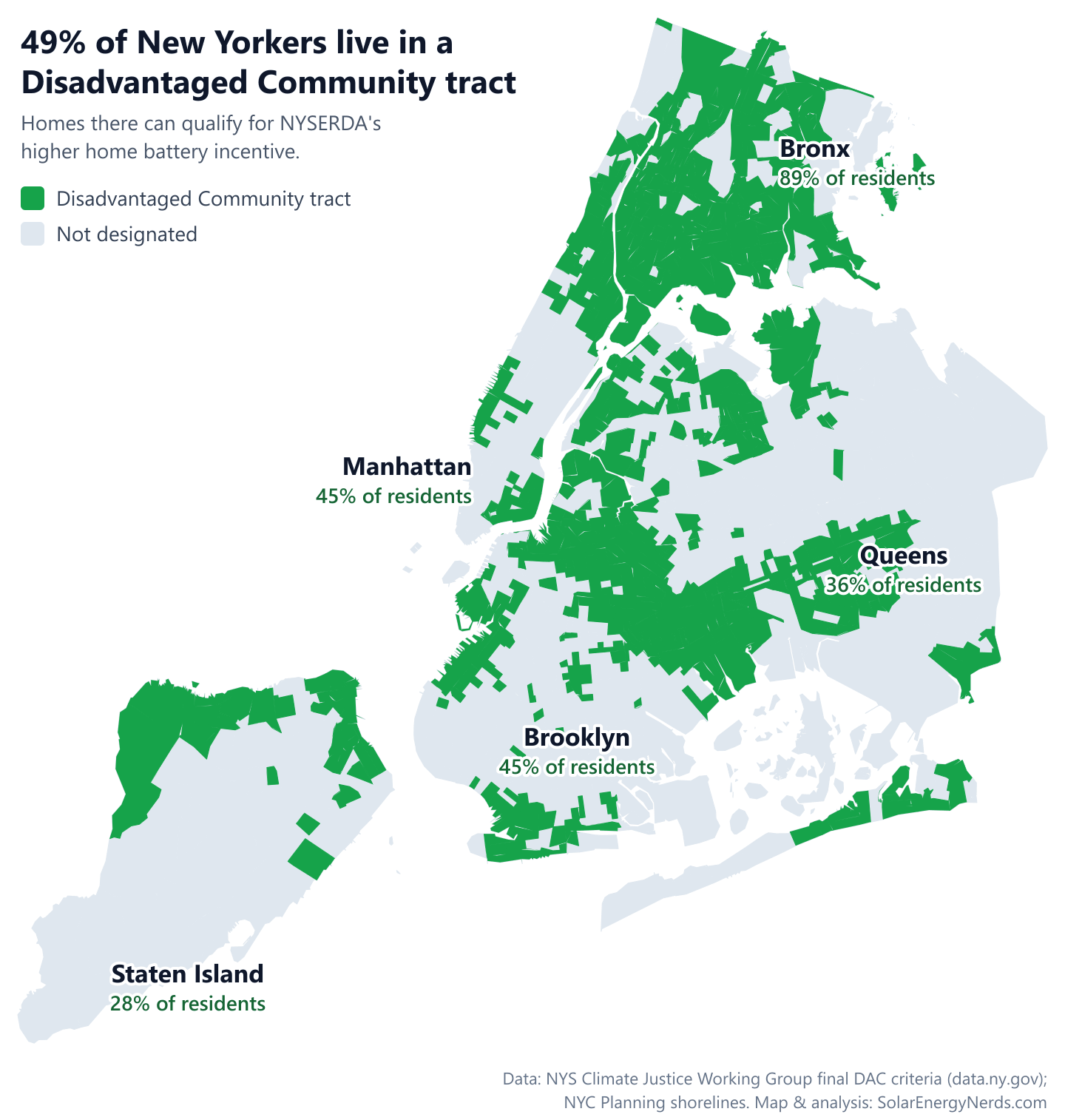
This map is licensed under Creative Commons Attribution 4.0 (CC BY 4.0). You may repost it, including commercially, as long as you credit Solar Energy Nerds and link to this page.
Download: PNG, 1440 px · SVG (vector)
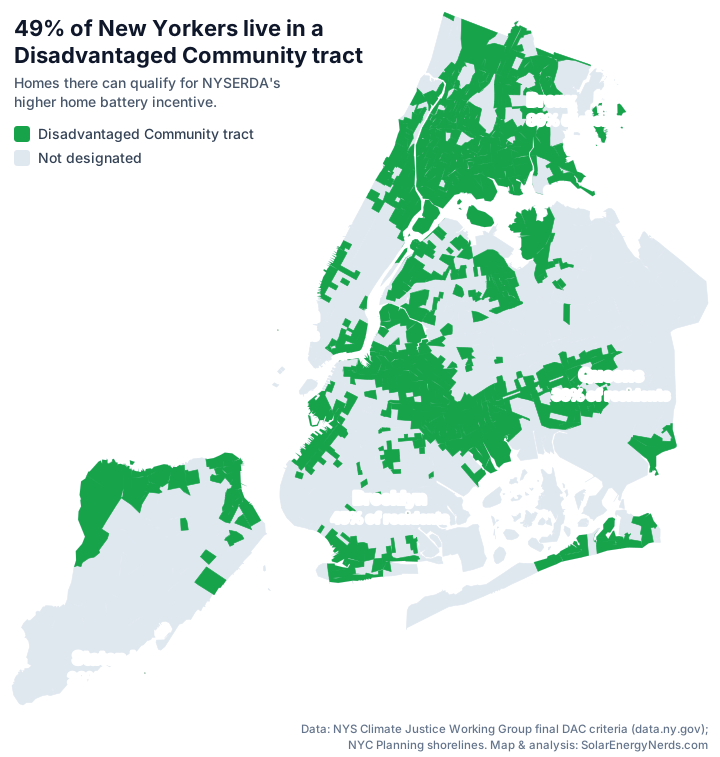
Embed code:
<a href="https://solarenergynerds.com/nyc-battery-incentives/"><img src="https://solarenergynerds.com/images/nyc-disadvantaged-communities-battery-incentive-map-1440.webp" alt="NYC Disadvantaged Community census tracts map" width="720"></a>
<p>Map: <a href="https://solarenergynerds.com/nyc-battery-incentives/">Solar Energy Nerds</a> (CC BY 4.0)</p>| Borough | Residents in DAC tracts | DAC tracts |
|---|---|---|
| Bronx | 89% | 283 of 339 |
| Manhattan | 45% | 120 of 288 |
| Brooklyn | 45% | 308 of 761 |
| Queens | 36% | 211 of 669 |
| Staten Island | 28% | 36 of 110 |
| New York City | 49% | 958 of 2,167 |
The tracts were set under New York's final 2023 criteria, which weigh pollution burden and population vulnerability. Eligibility is by exact address, so your installer confirms it before reserving your incentive.
Does the NYC property tax abatement cover batteries?
Yes. The city's Solar and Electric Storage System Property Tax Abatement covers a battery on its own or alongside solar. It's worth 30% of eligible installation cost, up to $250,000. The city applies it over four years (up to $62,500 a year), starting the July 1 after the Department of Buildings approves it.
- Who qualifies: Class 1, 2 and 4 properties, which covers 1–3 family homes, co-ops, condos, rentals and commercial. Properties getting ICAP, 421-a, 421-b, 421-g or paying PILOTs are excluded.
- What counts: materials, installation labor, and design and engineering. Interest and anything paid for with a government grant, including the NYSERDA incentive, don't count.
- Deadline: applications must be in by March 15 to take effect that calendar year. Your installer files it with the building permit.
- Window: systems placed in service from January 1, 2024 through December 31, 2034. Since 2024 you can also claim it again when you add a battery to existing solar.
Because it's a reduction to your property tax bill, each year's abatement can only be as large as the tax you owe.
What does Con Edison pay battery owners?
Con Edison's Bring Your Own Battery program pays $100 per kW of your battery's average performance during summer peak events. Events run May 1 to September 30 and last up to four hours, usually on weekdays between about 11 a.m. and 11 p.m.
- Eligible batteries (so far): Tesla Powerwall 2, Powerwall+ and Powerwall 3, plus SolarEdge systems with the BAT-10K1P or LG RESU10H battery. More brands are added as they're approved.
- How to enroll: through the Tesla app or SolarEdge's enrollment page, not through Con Edison directly.
- What it's worth: a 13.5 kWh battery spread over a 4-hour event delivers about 3.4 kW, or roughly $338 a summer at most. That's our estimate, and real payouts are lower if you keep a backup reserve. Tesla estimates about $360 in the first year.
See how this compares with other utilities in our virtual power plant guide.
Worked example: one Powerwall in Queens
A single Tesla Powerwall 3 (13.5 kWh) on a one-family home in Queens. Assumption: an installed price of $15,000. Your quote will differ, but the incentive math works the same way.
| Standard Con Edison rate | Disadvantaged Community rate | |
|---|---|---|
| Installed price (assumed) | $15,000 | $15,000 |
| NYSERDA incentive (13.5 kWh × rate) | −$3,375 | −$6,075 |
| NYC property tax abatement (30% of price minus NYSERDA) | −$3,488 ($872/yr × 4) | −$2,678 ($670/yr × 4) |
| Net cost after incentives | $8,137 | $6,247 |
| Plus Con Edison payments | up to ~$338/summer | up to ~$338/summer |
The Disadvantaged Community rate cuts the net cost by another $1,890. Part of the bigger NYSERDA check is given back through a smaller abatement. Every $1,000 your installer takes off the price lowers your net cost by $700, because the abatement shrinks by $300.
Is there a federal credit or sales tax on home batteries?
No federal credit for buyers in 2026. The 30% Residential Clean Energy Credit (Section 25D) covered batteries of 3 kWh or more, but it ended for anything installed after December 31, 2025. A federal benefit still flows through leases and PPAs, because the provider claims the commercial 48E credit.
No sales tax either. Residential energy storage equipment and its installation are exempt from New York State and local sales tax. That's worth 8.875% of the price in NYC. The exemption was set to lapse May 31, 2026, but the enacted 2026–27 state budget extended it through June 1, 2028.
Weighing whether a battery makes sense at all? See Is a Solar Battery Worth It in 2026? and our New York solar guide for the state tax credit and net metering.
Frequently asked questions
How much is the NYSERDA home battery incentive in New York City?
NYSERDA pays $250 per kWh for home batteries in Con Edison territory, which covers nearly all of New York City, up to 25 kWh ($6,250). Homes in a Disadvantaged Community or households that are income-eligible can get $450 per kWh instead, up to $11,250. Both blocks were open as of November 11, 2026, and your installer applies for you.
How do I know if my NYC home is in a Disadvantaged Community?
Disadvantaged Community status is set by census tract under New York's final 2023 criteria, so it depends on your exact address. About 49% of New York City residents live in a designated tract, including 89% of Bronx residents. Your installer confirms eligibility when they reserve your incentive.
Does the NYC property tax abatement cover home batteries?
Yes — New York City's Solar and Electric Storage System Property Tax Abatement covers battery storage on its own or with solar, worth 30% of eligible installation cost up to $250,000, applied over four years. Costs paid with a government grant, such as the NYSERDA incentive, don't count toward that 30%. Your installer files it with the building permit, and applications must be in by March 15 to start that year.
Is there a federal tax credit for home batteries in 2026?
No — the federal Residential Clean Energy Credit (Section 25D), which covered home batteries of 3 kWh or more, ended for anything installed after December 31, 2025. A federal benefit still exists for leased systems, but the leasing company claims it under the commercial Section 48E credit, not you.
Do I pay sales tax on a home battery in New York?
No — residential energy storage equipment and installation are exempt from New York State and local sales tax, and the enacted 2026–27 state budget extended that exemption through June 1, 2028. In NYC that saves the 8.875% combined sales tax.
What does Con Edison pay battery owners?
Con Edison's Bring Your Own Battery program pays $100 per kW of your battery's average performance during summer peak events, which run May 1 to September 30 and last up to four hours. Eligible batteries currently include Tesla Powerwall 2, Powerwall+ and Powerwall 3 and certain SolarEdge systems, and you enroll through the battery maker's app or portal.
Facts verified
NYSERDA rates, blocks and 25 kWh cap: NYSERDA Residential Energy Storage Incentive Dashboard and NYSERDA Home Energy Storage (both read November 11, 2026). NYSERDA incentive tied to utility BYOB enrollment: NYSERDA's January 22, 2026 Utility DLM Program Overview, as reported by installers; we couldn't open the NYSERDA document directly. Property tax abatement: NYC Solar and Electric Storage System Property Tax Abatement Fact Sheet. Con Edison payments and eligible batteries: Con Edison Bring Your Own Battery; first-year estimate: Tesla support. Sales-tax exemption: NYS Tax TSB-M-24(1)S; extension to June 1, 2028 per Hodgson Russ's summary of the enacted 2026–27 budget (Part Q). The Tax Department hadn't published updated guidance when we checked. Disadvantaged Communities: NYS Final Disadvantaged Communities (2023); borough shares are our population-weighted calculation. Federal credit expiration: IRS One Big Beautiful Bill FAQ. Installed price in the worked example is an assumption, not a quote.